
Safety Guides
Discover the latest in product safety, recall procedures, and tips to protect your household.
Discover the latest in product safety, recall procedures, and tips to protect your household.


There is no single search that covers every product recall in your country. Australia, the United States, the United Kingdom and Canada each split recalls across four or five separate government databases, and none of them lets you scan a barcode to get an answer.
This page tells you which official tool to use for your product, what information you need before you start, and why a search that returns nothing does not always mean your product is safe
Use the tool that matches your product category. If you are unsure which category your product falls into, check more than one — the boundaries are not obvious, and this is the most common reason people miss a recall.
Australia
General consumer products, toys, appliances, nursery goods — Product Safety Australia (ACCC)
Food — FSANZ food recall alerts
Cars, motorcycles, road vehicle parts — Vehicle Recalls Australia
Medicines, supplements, medical devices — TGA Database of Recalls, Product Alerts and Product Corrections
Pesticides, veterinary chemicals — APVMA agvet chemical recalls
United States
Toys, appliances, furniture, nursery products, most household goods — CPSC Recalls
Food, except meat and poultry — FDA Recalls, Market Withdrawals & Safety Alerts
Meat, poultry, processed egg products — FSIS Recalls & Public Health Alerts
Vehicles, tyres, car seats — NHTSA recall lookup
Complete food and drug enforcement records — FDA Enforcement Reports
United Kingdom
Toys, appliances, electricals, most consumer goods — Product safety alerts, reports and recalls (OPSS)
Food and allergen alerts — FSA Alerts
Vehicles and vehicle parts — Check if a vehicle has been recalled (DVSA)
Medicines and medical devices — MHRA alerts and recalls
Canada
Food, consumer products, health products, vehicles — Recalls and safety alerts
Vehicle campaign detail — Transport Canada Motor Vehicle Safety Recalls Database
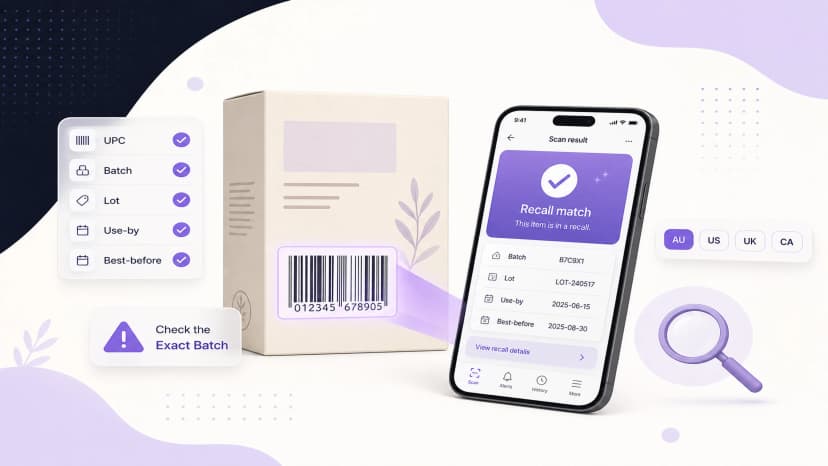
Product name and brand are rarely enough. Most recalls apply to a subset of a product line — specific batches, date codes, serial ranges or a particular retailer. Have the product in front of you.
On food: the batch or lot code, and the best-before or use-by date. Look near the date marking, on the crimped seal, the tin lid or base, or the ink-jet panel on the back label. On a multipack, check the outer carton as well as the inner unit — the code is often only on one of them.
On toys, prams and car seats: the model number and manufacturing date. Check the underside, the battery compartment, the frame, or the sewn-in label on fabric parts.
On appliances and electricals: the model number, serial number and date code, all usually on the rating plate. That plate is often on the rear, the underside, the door frame or an internal edge — which is why people struggle after installation.
On vehicles: the 17-character VIN, on the lower driver-side windscreen, the driver door jamb, or your registration papers. Note that the letters I, O and Q never appear in a modern VIN, so if you think you see one, it is a 1, 0 or 9.
When the notice names no code at all: some recalls are scoped by retailer and sale period instead — "sold at X between March and June". In that case what matters is your purchase record: order history, card statement, loyalty account or marketplace receipt.
Not on any official government tool. We checked every national recall database across Australia, the US, the UK, Canada and the EU in August 2026, and none of them offers a camera barcode scan. None has a dedicated barcode field either. You can type a barcode number into most of them, but it will only match if that number happens to appear in the text of a notice.
The closest official tools to a real scan are for vehicles: NHTSA's SaferCar app can capture a VIN, and the UK checker takes a registration number. Neither reads a retail barcode.
There is also a deeper reason a barcode cannot always answer the question, and it is worth understanding before you trust any app that claims otherwise.
A retail barcode carries a GTIN, which identifies a product line — not a production run. The same 13 digits sit on every jar of a given sauce, whether it was made in January or in June. When a recall covers only certain lots, a barcode match alone cannot tell you whether your jar is affected. An app that answers "recalled" on the barcode alone will produce false alarms.
The reverse also happens. Packaging refreshes, regional variants, multipacks and different pack sizes often carry different barcodes even when a notice describes them as one product family. A barcode that returns nothing does not clear you.
Modern 2D barcodes — the square GS1 DataMatrix codes appearing on some packaging — can encode the batch, expiry and serial alongside the product number. That is enough to answer the question properly. But it only works if the manufacturer encoded that data, the app reads it, and the recall notice publishes matching identifiers. All three rarely line up today.
If you use a third-party scanner app, look for what it actually checks. A camera icon does not mean it reads batch codes.
Stop using the product first. Then follow the remedy in the notice — it will specify repair, replacement, refund, or safe disposal.
Australia. Under Australian Consumer Law, a major failure gives you the choice of a refund or a replacement. For a minor failure the supplier usually gets first opportunity to repair it. You do not necessarily need the receipt — a bank statement or other proof of purchase generally works.
United States. The remedy is set out in the recall notice itself. It is provided free of charge, and for vehicles a dealer must carry out safety recall work at no cost.
United Kingdom. Your rights sit under the Consumer Rights Act 2015, alongside whatever the recall notice offers.
Canada. Follow the notice; remedies vary by product and by the agency involved.
Take a photograph of the product, its label and any identifying codes before you return or dispose of it. If there is a dispute later, that photo is the only evidence you will have.
On disposal: never put a recalled lithium-ion battery or battery-containing device in household waste or ordinary recycling. Some recall notices give specific disposal instructions, and household hazardous waste facilities may need advance notice before accepting a recalled battery.
A blank result is not the same as an all-clear. These are the most common reasons a real recall does not show up:
You checked the wrong regulator. The single biggest cause. A US meat product is FSIS, not FDA. An Australian supplement is TGA, not ACCC. A UK food item is FSA, not OPSS.
It is not called a recall. Regulators publish safety warnings, public health alerts, product safety reports, withdrawals and advisories that carry real safety consequences without using the word "recall". Filtering to recalls only can hide them.
The identifier is in an attachment. Long VIN lists and serial ranges are often in a linked PDF, which the search index may not read.
Formatting mismatch. Leading zeros, spaces and hyphens matter. A GTIN typed without its leading zero will not match.
The notice was expanded later. Recalls frequently grow to include additional lots, dates or products. A search from six weeks ago may no longer be accurate.
The campaign is too new. NHTSA states plainly that a recently announced recall may not return results yet, because affected VINs are still being loaded.
The archive does not go back far enough. The CPSC website shows ten years, though its full dataset reaches back to 1973. The TGA database starts at 1 July 2012. RASFF's public search starts in 2020.
The product was banned rather than recalled. A product can be illegal to sell without ever appearing in a recall database. Baby walkers are prohibited in Canada. In Australia, products failing a mandatory safety standard can be unlawful to supply with no recall notice attached.
Recalled products do not disappear from circulation. They move into the second-hand market, where the original packaging, labels and paperwork are usually long gone — and where the person selling may have no idea a recall exists.
In the United States, federal law prohibits the sale, offer for sale or distribution of products subject to CPSC recalls. In Canada, the Consumer Product Safety Act defines "sell" to include giving something away, so passing on a recalled item without payment is still covered. Australian and UK rules require businesses selling second-hand goods to supply safe products that comply with bans and mandatory standards.
If you are buying second-hand, check the model before money changes hands. If you are selling or giving something away, check it first — particularly nursery products, where standards have changed significantly over the past decade.
The research on this is consistent and somewhat sobering.
NHTSA's April 2026 report to Congress calculated a weighted-average completion rate of 65.8% for mature vehicle recalls initiated between 2012 and 2022. Roughly a third of recalled vehicles were never brought in. Completion was near 87% for vehicles recalled within three years of manufacture, and fell steadily with vehicle age.
Vehicles are the category with the best infrastructure — mandatory registration, a national VIN database, dealer networks obliged to repair free of charge. Consumer products have none of that.
The reasons documented by regulators are mundane: people move house, ownership changes, registration data goes stale, product registration cards are never returned, labels sit underneath appliances or inside battery compartments, and a recalled item that still works does not feel dangerous.
It can be done better. The Takata airbag recall in Australia — a compulsory recall, with sustained coordination — reached 99.9% completion by March 2021. The gap between 65.8% and 99.9% is not a technology gap. It is a matter of whether anyone keeps following up.
Is there one website that checks all recalls? No. Not in any of the countries covered here. Canada's federal portal comes closest, unifying food, consumer products, health products and vehicles, but even it hands off to manufacturer tools for unit-level vehicle checks. Australia, the US and the UK all require four or five separate searches.
Can I check a product by barcode? Not on any official government tool. You can type a barcode number as a search term, and it will match if that number appears in a notice, but no national regulator offers a camera scan. Some third-party apps do — check which identifier they actually read before relying on one.
How quickly do recalls appear online? It varies, and most regulators do not publish a figure. Australian suppliers must notify the ACCC within two days of taking recall action. The TGA database deliberately runs two days behind. CPSC recall data refreshes weekly. Canada's open data feed updates daily. NHTSA adds VINs to new campaigns continuously, so a very recent recall may not return your vehicle yet.
My product isn't listed. Is it safe? Not necessarily. Check the other regulators for your country, try the search without filtering to recalls only, and confirm the notice has not been updated since you looked. A product can also be banned or non-compliant without a recall notice existing at all.
Do I need a receipt to get a refund? Usually not. In Australia, other proof of purchase such as a bank statement generally suffices. Most recall remedies are offered regardless of proof of purchase, because the aim is getting the product out of use rather than settling a sales dispute.
RecallScope follows official government recall sources across Australia, the United States, the United Kingdom and Canada, plus Germany and France through EU Safety Gate. Every notice links back to the original agency publication.
Reading recall information on RecallScope is free.
RecallScope is an independent service and is not affiliated with any government agency or regulator. Always follow the instructions on the official agency notice.
Follow RecallScope for official-source recall explainers, safety tips and the most important updates. We auto-detect your country and timezone when possible.
RecallScope Team
10 min read
RecallScope Team
11 min read
RecallScope Team
67 min read
RecallScope Team
10 min read
RecallScope Team
11 min read
RecallScope Team
67 min read
